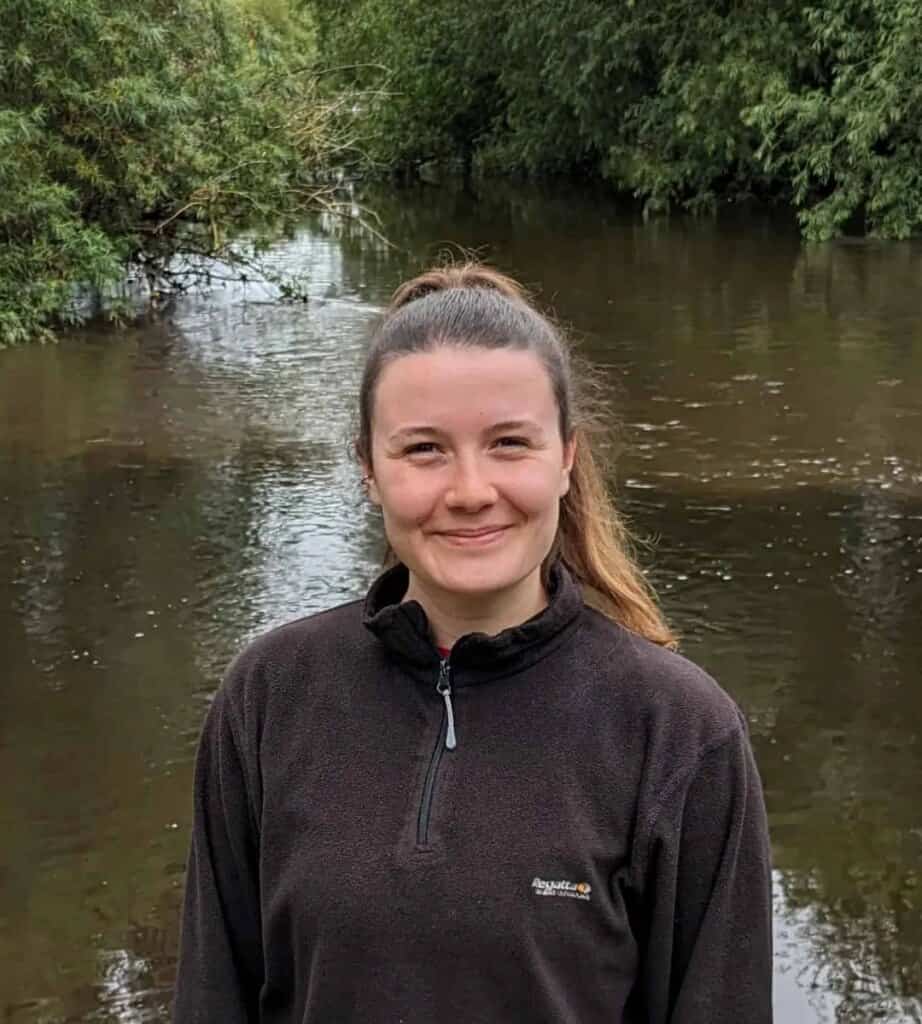
Gareth Muir
We continue our series of interviews by Lucy Johnson, in which she interviews some of the key players in the development past, present and future, of The Aire Rivers Trust. We thank her for her commitment and expertise in putting these pieces together.
Gareth was a Project Officer during a critical phase of our development, when we were challenged by an increasing number of projects, funders and reporting requirements. He made a great contribution to our Trust and this interview was recorded shortly before he left for pastures new as the Local Environment and Allotments Officer at Hebden Royd Town Council,
Lucy
What personal qualities make you a good project manager?
Gareth
Having interpersonal skills. The number one quality is patience. Patience is what you need to work with people. I’m very much of the school of thought that human beings should be in nature. We are part of nature. This seems to be quite in vogue at the moment with rewilding and so on. We need to let nature get on with its own devices.
Also, being diplomatic and for example, in office dynamics, being the hate figure.
Not a serious hate figure but being the person who’s a little bit crabby sometimes, who sort of pushes the envelope with socially acceptable discussions and mores, etc. In a productive way, not in an antagonistic way. Then again that’s sort of similar to how within the team, Olivia is the good cop and I’m the bad cop.
Lucy
Do you get into a flow state while you’re working or undertaking practical tasks?
Gareth
Yes, I do. And that’s not ideal because you’ve got to have your wits about you because you’re obviously supervising people. So for example, mowing today, I’m always aware that I need to be available. I can’t just go into a state of flow where time passes me by and I’ve mown X amount of grass, but I’m perhaps neglecting altering people’s technique or sharpening a blade and things like that.
So, it can be quite taxing in terms of your concentration.
Lucy
What’s the most satisfying element of project management for you?
Gareth
Well, surprisingly enough, completing a project, as much as I love the process. So for example with the River Aire Care 2 Stewardship Fund, we didn’t have to necessarily report and have specific outcomes, but we did an end of project summary and we had over a thousand bin bags from the river cleanups.
We’d laid over 200 meters of hedge and planted thousands of trees. When you put those numbers into black and white, it becomes quite real in that respect. For me it’s about offsetting my carbon. I know that if I plant 282 trees in a year, I offset the carbon, which through my positive life choices I’ve been able to do that.
Whereas some people would say, “Oh well, you’re really lucky that you get able to do that as well.” No, I’ve chosen this life to do this. You know, like you’ve not chosen to pay for somebody to do that. You’ve not chosen to go out and do that yourself as an intervention. Whereas the volunteers I work with have put their money where the mouth is, have come out and contributed to a project which has actually got tangible results.
Then in years to come, they’ll be able to say, oh, well, I planted that tree, or I pulled that car out of Bradford Beck. Rather than getting lost in the process, the actual result at the end of it is something to be celebrated and, you know, that is what we do it for.
Lucy
In terms of projects are the volunteer days, the end point, the midpoint or something else?
Gareth
That’s an interesting question. Probably the midpoint, because there’s planning for a session, carrying out a session and then you’ve got the outputs. So for example, we’re on Baildon Floodable Meadow today. We are mowing X metre squared of meadow and that’s the end result. Then that feeds into the habitat management side of things.
I guess it’s one of the questions which people who work in the sector as project officers doing environmental conservation get, “So what do you do with your time? It must be nice just to come out two days a week and do some mowing or do some coppicing.” Those other three days of the week, it’s site visits, it’s liaising with landowners, it’s writing risk assessments, it’s writing out method statements of how are you going to do it, why are you going to do it?
There’s also volunteer coordination, which is sending out the emails, instructions, communicating with the volunteers, clarifying any issues which might have arisen. Part of the role is volunteer recruitment. So for example the people who sign up for the Better Impact website, going through their application, maybe signposting them to Sam to do Citizen Science rather than practical conservation. There’s volunteer management, for example, if somebody’s done a course, updating the first aid and identifying training which they might like to carry out. So it’s quite a broad spectrum of tasks. I know from experience in the third sector, you’ve got to have many strings to your bow and you’ve got to be able to do social media and do community engagement.
So it’s a broad canvas really.
Lucy
What have been some of your biggest achievements at the Aire Rivers Trust?
Gareth
Being a good mentor for Olivia has been my main achievement. In this sector, there’s a lot of turnover of staff when one project ends and another begins. Organisations struggle to keep staff, then they’re trying to keep the knowledge, skills and experience to bridge that gap in terms of following it along. Humans, despite all of our faults, I’m a great believer, are the best resource to have.
In terms of more tangible results, I think growing the volunteer offer, including more people in the volunteering, increasing engagement with corporate groups such as the Airedale Group who pledged over 200 hours. Getting Keighley College students involved, making more links in the community, that’s always important. That’s an element of particularly environmental project officer roles, which you can’t learn, you can’t go to university and do a degree in it. You have to do that community building on the ground and make those links and have interpersonal skills.
Lucy
If you came back in two years and popped your head in the office, what would you like to see as your legacy of things that you can tell, “I had a part in that, that’s still there”?
Gareth
I don’t necessarily know if my legacy would be in the office. I think the volunteer base is an interesting one and very representative of volunteering in general. You’ve got people who are retired, semi retired, middle class, middle aged, some from a British background ethnically. I found it very open, very accommodating. For example, new people come into the group and they assimilate well into the group. I’d like to think Olivia will continue to foster a culture of openness, inclusion. I think that has existed previously in terms of the qualities of the staff. Sam has very similar qualities in that respect and so does Nick as well. So I think the trustees have made good choices in terms of who they’ve recruited. It’s really fitted within the existing culture and then it’s more a case of adding to the culture rather than changing or diverting it.
It’s very much like, if you want to use an analogy of the river, allowing the river to flow in its own direction rather than trying to put up a wall which channels the energy in a destructive direction. It actually follows its own course and deposits the good things like the silt of good teamwork, etc, etc and erodes the bad things like fixed mindsets and inflexibility.
I think in terms of what the legacy might be, I’ll be leaving, but then there’ll be new members of staff coming in. Hopefully they will be able to join the team and work with the team, not just alongside them and co-produce things rather than being like, “oh, well, we need to knock down 10 weirs regardless.” Somewhere down the line you might figure out, oh, actually this one weir has more benefits, than negatives and think, “oh, I need to keep this” for whatever reason.
Tangibly, I’d like to see more work on the sites. So for example Bingley North Bog, I’d like to see the proposed plans for having a screen there for observing birds. Or for Bingley South Bog, the willow being cleared out to increase the diversity of it. Also in Ryeloaf Meadows, to diversify the species of trees in there. As for Trench Meadows, ensuring that it’s not encroached upon by dog walkers and dog fouling, diminishing and degrading the quality of it.
That would be the legacy I would like to see.