
In her last blog, Lucy Johnson interviewed our former Project Officer Gareth Muir. This time she follows him to his new role as Local Environment and Allotments Officer at Hebden Royd Town Council.
If you want to manage a meadow, should you happen to have one lying around, ungulates (hooved animals) can be a great choice. Switching roles last summer from Aire Rivers Trust Project Officer to Local Environment and Allotments Officer at Hebden Royd Town Council, Gareth Muir seems delighted to have sheep to help him reduce coarse plants in High Hirst Meadow. Their dung will help fertilise the soil, and knocking back coarse plants will encourage native wildflowers. This will also protect the presence of the type of fungi you might not be able to immediately identify, but which could potentially lead to Site of Special Scientific Interest status (SSSI). The specific fungi identified here are still awaiting an official moniker. The site is also significant for the rare grassland preserved here due to local conditions.
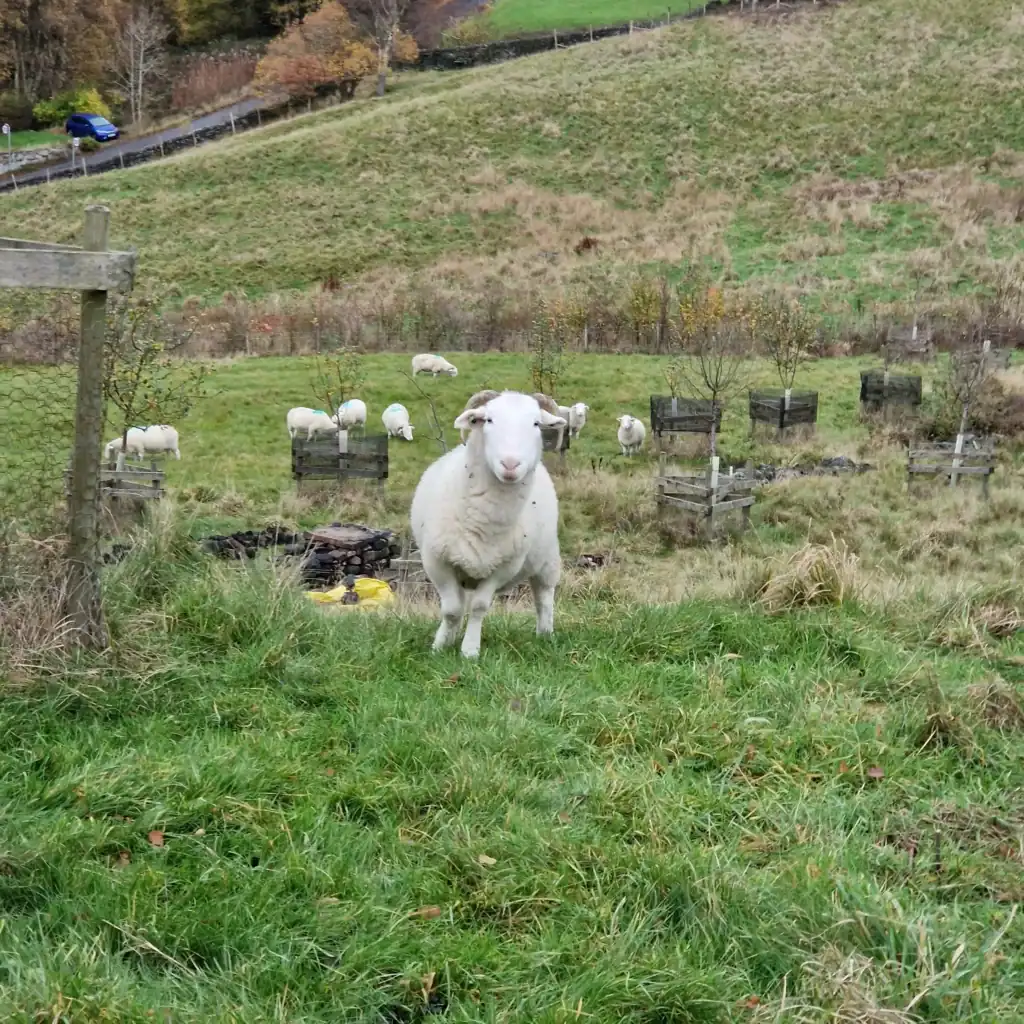
The sheep are stocky, with handsome white faces, and are a fairly local conservation breed, Whitefaced Woodland sheep. Both rams and ewes typically have horns. There is mild scepticism over the parentage of next year’s lambs, but it doesn’t sound like Gareth is going in for full-scale sheep farming, although I’m sure he’d relish the challenge. The sheep show mild interest in us as we arrive, hopeful of a few sheep nuts, but soon settle back to their allotted task.
Gareth keeps an eye on them to see if they’re showing any interesting social behaviour, or are opportunistically nibbling away at any other plants, such as the Guelder Rose they’ve recently been spotted snacking on.
I’m aware that the majority of this blog’s readership will know far more about sheep than I do (not difficult), so please do forgive me the following few lines of flights of fancy. Skip ahead if like me you find anthropomorphising irritating. These sheep have an “aire” of knowing what’s what. They look at us calmly and confidently, and stand their ground. Maybe they started off like that, or maybe Gareth has influenced them in becoming more savvy.
The meadow lies on the east side of Hebden Bridge, reached by a ginnel from the town centre. I would dearly like to insert a scenic, rural description of the route here, emphasising the quaintness and suchlike. However, on arrival at the Town Hall in the centre of Hebden Bridge, Gareth took in the state of me and the size of my backpack and offered to drive up. I accepted with alacrity, having already been on several forms of transport and walked four miles to have a quick gander at the nearby Hardcastle Crags prior to our 11am start. A gentle four mile walk, true, but I’m not sure I believe in pre-midday exertion without just cause. The permissive footpath through the site is temporarily closed for the crack team of nibblers to enjoy their canapés undisturbed. However, the path has been recently improved for walkers with the addition of some subtle steps over part of the slope, which still preserve the integrity of the landscape. The sheep are expected to visit for around 6-8 weeks yearly, although they arrived late in 2025 due to paperwork.
There is a lot of hard work to be done on this relatively small site, which has been in development as an environmental project by Hebden Royd Town Council since March 2019 as a response to climate conditions. Although traditionally these area has dry stone walls, there is a deer-reduced hedgerow in one section, and also a lower boundary hedge to be partly grubbed up. Not the usual option, but when the hedgerow has been thickly planted with blackthorn, there aren’t many ways of avoiding the thickets arising from the blackthorn’s root suckers interaction with the clay below the top soil, which prevents tap roots forming.
Characteristically, Gareth utilised the growing community fruit orchard to test my tree ID skills. Said skills haven’t exactly plateaued since Gareth left, but my repertoire never included fruit trees in the first place. It seems unlikely that it will in the future either, after being shown two pear trees, which had completely different buds. I remain in the dark about what another tree was, presumably because even my incorrect guesses were too wide of the mark for Gareth to have anything to work with.
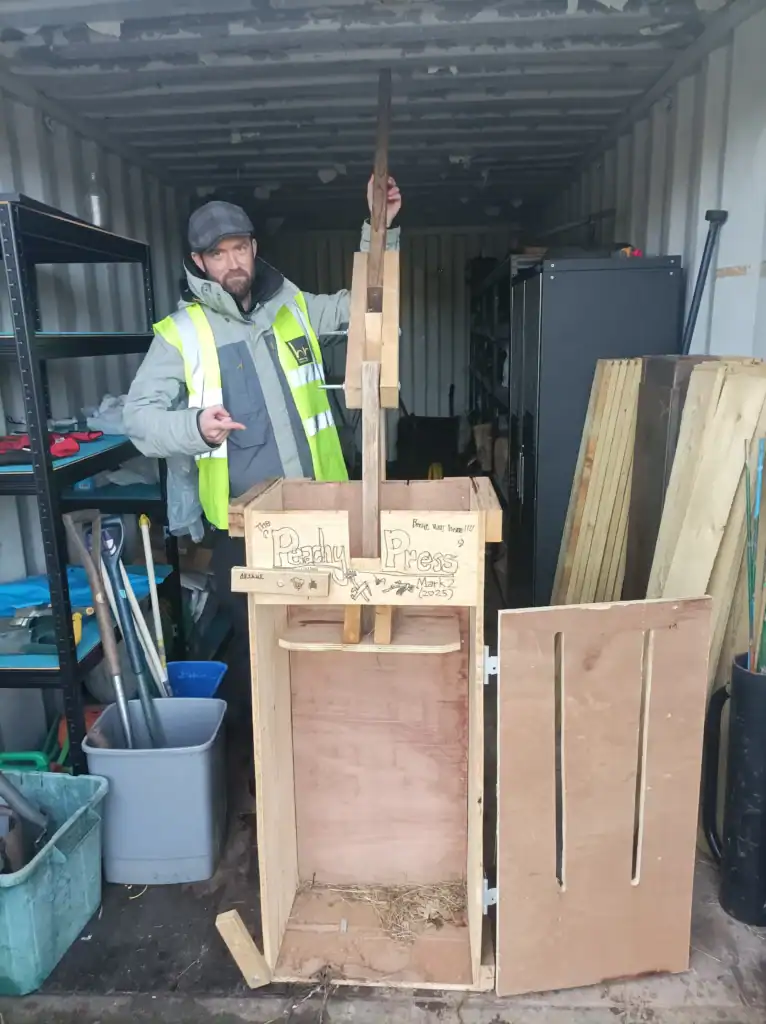
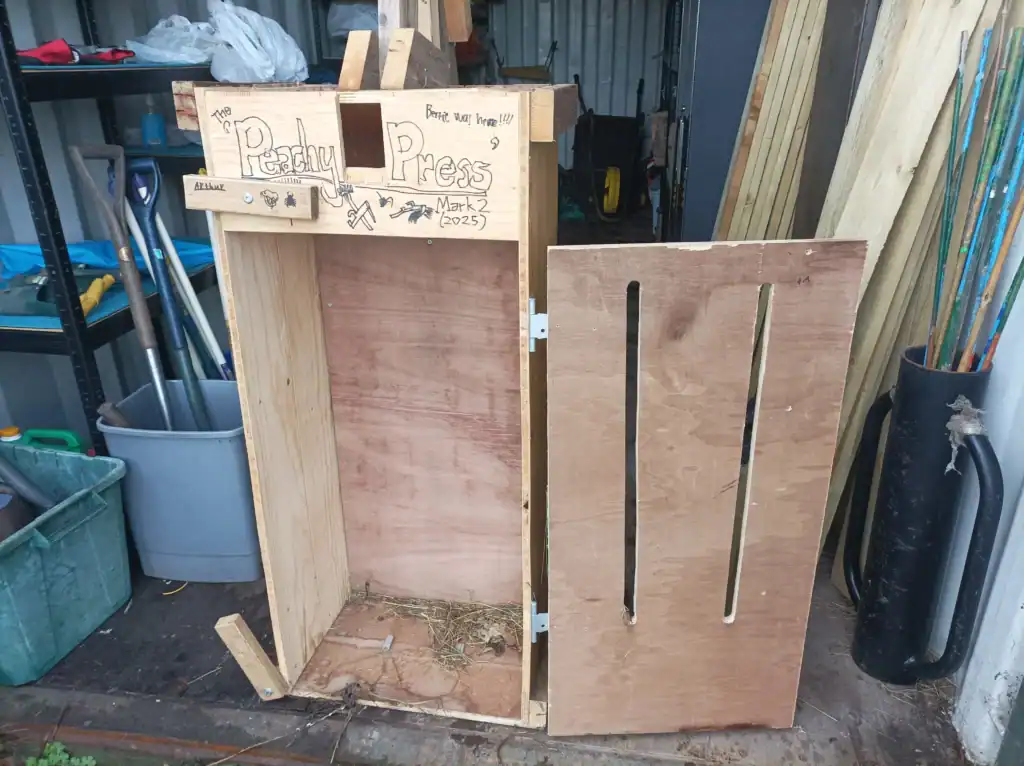
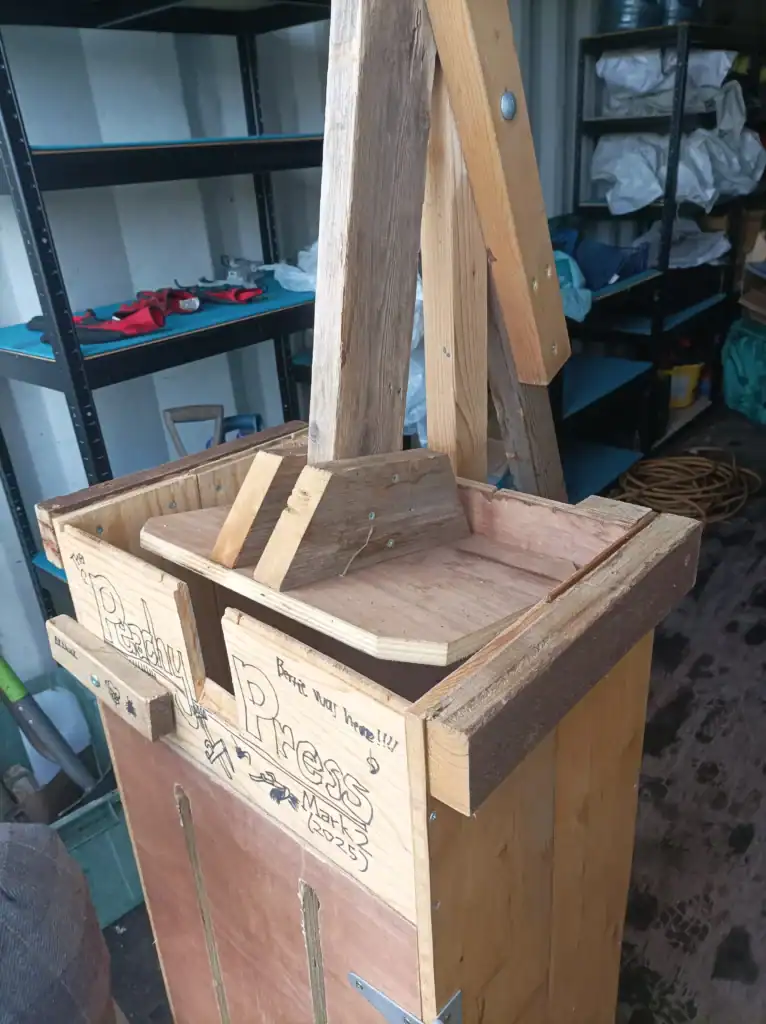
There is a slight sense in the air that the sheep, if left to themselves could manage Gareth’s new contraption, made by ecologist Steve Hindle, a Calderdale expert on fungi and plants. Affectionately known as the Peachy Press, this device reduces some of the labour in the labour intensive process of making hay. The scythed and dried hay is gathered and placed in the box, with twine looped through at the bottom, then the handle presses it all down. Most of the hay goes to a local animal sanctuary, although some is also available to buy for pets.
The plans for this device are a closely guarded secret (read: it didn’t occur to me to ask about them at the time), and the manufacturing run has heretofore been limited. Not owning a hay baler myself, I can’t be too sure on this, but it seemed to be not that space-consuming, despite its height, as you could easily stash other items in it out of season.
Post a wedge of apricot and cardamom cake each, Gareth was back to the office, and I was back to the train station. If you would like to keep your hand in with scything over summer 2026, Gareth is keen to have scything volunteers to attend this site. Drop an email to Gareth at gareth.muir@hebdenroydtowncouncil.gov.uk if you are interested.
https://www.jokennedysound.com/naturetripping/nature-tripping-episode-28-grassland-fungi Listen to Steve Hindle on fungi
https://hebdenroydtowncouncil.gov.uk/your-community/climate-emergency-biodiversity/high-hirst-woodmeadow/ More information on the meadow
https://whitefacedwoodland.co.uk/ More on Whitefaced woodland sheep
https://www.nationaltrust.org.uk/visit/yorkshire/hardcastle-crags/the-grassland-fungi-project-at-hardcastle-crags More information on Hardcastle Crags